



Ekep Nkwelle – A straight talking rootsy vision
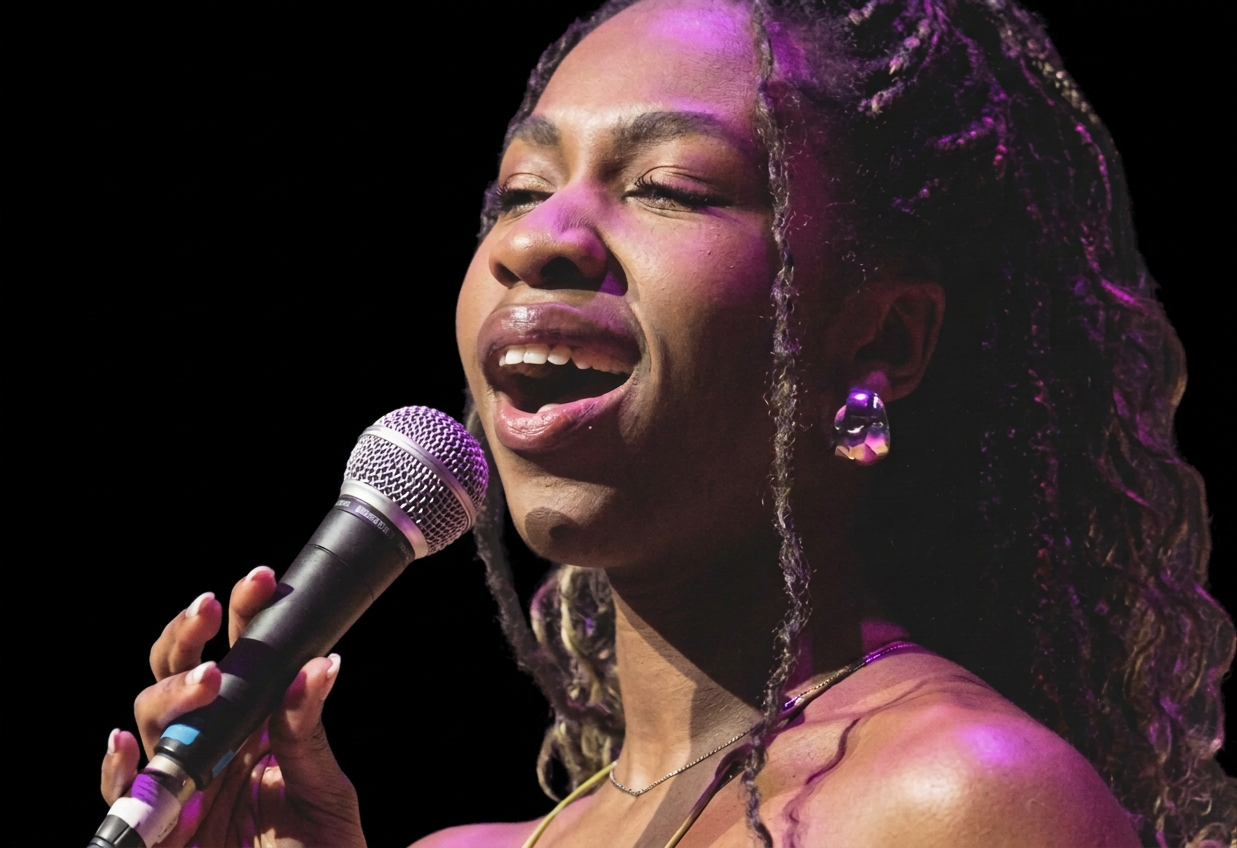
American singer Ekep Nkwelle’s debut is rooted in gospel and blues but is firmly a jazz record too. The album repertoire moves from the devotional ‘His Eye Is on the Sparrow’ to Abbey Lincoln’s ‘Caged Bird’, the Broadway song ‘Night Song’, Djavan’s ‘Amazon Farewell’, Billie Holiday’s ‘Good Morning, Heartache’, ‘The Sad Ones’, ‘The Creator Has a Master Plan’ and ‘See See Rider’. It is a wide ranging selection, although I’m not particularly taken with either the song or Nkwelle’s version of ‘Amazon Farewell’. That aside elsewhere, though, there is enough coherence in the choices and arrangements to make this a promising debut that should find an audience on specialist jazz radio.
Nkwelle is preoccupied by songs concerned with suffering, endurance, faith and the possibility of something beyond them. It is an idea that connects with the album’s inspiration in Maya Angelou’s haunting memoir I Know Why the Caged Bird Sings from 1969. The opening ‘His Eye Is On The Sparrow’, written by Civilla D. Martin and Charles H. Gabriel in 1905, is a long established gospel standard recorded by artists including Mahalia Jackson and Ethel Waters. Nkwelle’s reading is relatively spare and gives the melody room to speak before Abbey Lincoln’s ‘Caged Bird’ brings the title theme into sharper focus.
‘Night Song’, written by Lee Adams and Charles Strouse for the 1968 musical Golden Boy, takes the record into Broadway territory.
Sarah Vaughan recorded it on ¡Viva! Vaughan in the mid-1960s. Nkwelle is even more convincing when she moves towards the rootsier side of her voice, as she does with some exuberance on ‘See See Rider.’
‘Good Morning, Heartache’, written by Irene Higginbotham, Ervin Drake and Dan Fisher, is perhaps the most familiar piece of vocals jazz territory here. Billie Holiday’s recording remains the inescapable reference point, while Diana Ross gave the song a very different profile on Lady Sings the Blues. Nkwelle’s reading is controlled and intimate, finding the ache in the song without pushing it towards melodrama.
I liked ‘Early One Mornin’’ best of all, while ‘The Sad Ones’, composed by Washington saxophonist Roger Wendell ‘Buck’ Hill, is particularly interesting because Nkwelle supplies her own lyrics which are hard hitting and prove an unflinchingly feminist statement.
Surrounding the voice Luther Allison plays piano on the opening two tracks, with Julius Rodriguez taking over from ‘Night Song’ onwards. Russell Hall plays upright bass throughout most of the album and Brian Richburg Jr is on drums, with Allison and Richburg also adding percussion and tambourine on ‘Early One Mornin’’. Rodriguez comes through particularly clearly on the later tracks.
The other major reference point is Pharoah Sanders’ ‘The Creator Has a Master Plan’, originally recorded on Karma in 1969 with Leon Thomas. Nkwelle’s version is a little too middle of the road for my taste. The closing ‘See See Rider’, first recorded by Ma Rainey in 1924, is far better and brings the album back towards more direct blues territory and makes a robust final statement. That and the black church gospel domain is where its heart beats strongest.
The most intriguing moments are those in which she sounds less like a singer demonstrating what she can do and more like an artist working out what a song can mean.









Leave a comment