
Jason Moran steps down from the Kennedy Center
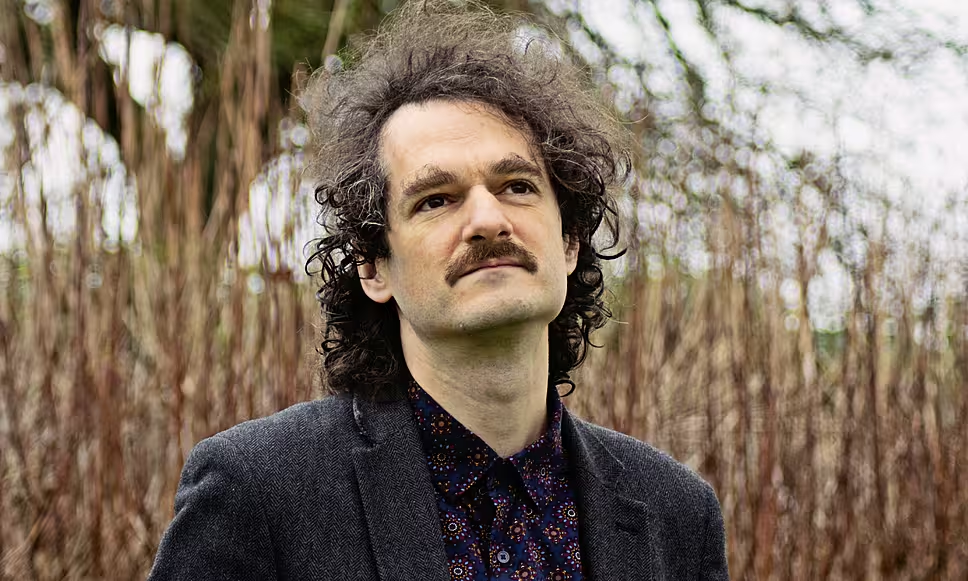
More grim news from the States emerges as the pointedly hard right wing wrecking ball upheaval at the Kennedy Center continues with the departure of pianist and composer Jason Moran as artistic director after 14 years at the prestigious Washington DC venue.
NPR comments: “A number of artists have cut ties with the Kennedy Center since President Trump abruptly ousted president Deborah Rutter and board chair David Rubenstein, replaced board members appointed by former President Biden with his own, and became chair himself earlier this year.”
It makes you wonder at an ocean’s distance how jazz in America is going to be affected over the next few years by Trump’s hostility to a community whose anti-MAGA politics are radically at odds with his own. Certainly I can’t see any self respecting jazz musician accepting an invitation to any relevant event at the White House or taking part in any Trump backed initiative if there are even any.
Ponder these words of Irina Bokova, a former Director General of UNESCO, who spoke at the celebration of the International Jazz Day in 2016: “Jazz is about civil rights, is civil dignity. It was the soundtrack of struggle in this country and I would say beyond. But jazz is also about diversity.”
But a current intrusion on Diversity, Equity and Inclusion (DEI) is just one parlous development among many pursued by the Trump administration. And the American jazz community’s response to the Trump administration has proved not surprisingly hostile.
Because the administration has repeatedly called for the elimination of the National Endowment for the Arts a prominent backer of jazz in America and shifted funding priorities away from broad artistic support. Musicians like saxophonist Noah Preminger have described the potential loss as tragic, noting that federal funding for jazz and the arts in the U.S. was already limited.
And at events like Manhattan’s Winter Jazzfest the focus has shifted to social justice, with panels such as “Social Justice and Jazz” led by drummer Terri Lyne Carrington, writer Siddhartha Mitter and ACLU [American Civil Rights Union] policy researcher Megan French-Marcelin. These discussions connected the Trump era to previous waves of political jazz, from the civil rights movement to Black Lives Matter, and explored how the administration’s rhetoric and policies – especially those affecting marginalised communities – heightened the urgency of jazz as a platform for activism. Musicians, writers, and advocates discussed the need for jazz to serve as a voice for resistance, drawing on the music’s historic role as a vehicle for social commentary and change.
Protest music such as Max Roach’s in the 1960s is again relevant
In February this year, a group of 34 dancers staged a performance of Pina Bausch’s The Nelken Line outside the Kennedy Center in Washington, D.C., to protest against Trump’s direct control over the institution’s board and programming. The demonstration highlighted concerns about a shift toward more Eurocentric and less diverse artistic offerings, reflecting broader anxieties in the jazz and arts communities about representation and inclusivity under Trump-appointed leadership. The administration’s attacks on DEI initiatives and affirmative action in education and the arts further galvanised the community, which has deep roots in African American culture and has historically relied on such programmes to foster opportunity and representation.
Reports and commentary from within the jazz world describe a sense of marginalisation, with jazz and other non-mainstream art forms pushed to the periphery of public life. Some accounts, though satirical or hyperbolic, captured the anxiety of the era: the notion of jazz artists being labelled as subversives, jazz education programmes disappearing, and major cultural institutions shifting their programming away from jazz in favour of more overtly patriotic or commercially safe fare. The sense of jazz as an art form born of struggle and resistance is to an extent reinvigorated, with many artists embracing their roles as cultural dissenters.
Personal activism has also been prominent. Saxophonist Jimmy Greene, whose daughter was killed at Sandy Hook Elementary, has become a vocal advocate for gun safety, using his music and public platform to call for change in the face of Trump’s support for gun rights and deregulation. Educators such as Danilo Pérez at the Berklee Global Jazz Institute has encouraged outreach to regions that had supported Trump, emphasising the role of jazz in bridging divides and fostering dialogue.
Harvard professor and leading jazz pianist and composer Vijay Iyer has commented: “The day after the election, I played a concert with this man sitting next to me, [trumpeter] Wadada Leo Smith. I can’t tell you how grounding it was. I was as shocked as anybody. But I have known Wadada a long time, and I’ve gained a sense of what he’s lived through, what he’s witnessed in his lifetime, growing up in Mississippi and then living in Chicago, growing up near where Emmett Till was killed, experiencing the Chicago that killed Fred Hampton. Oppression is not new. And this music has always been about resistance.”
MORE FROM MARLBANK



Comments are closed.