


The leaves began to fade
Like promises we made
How could a love that seemed so right go wrong?
– Sammy Cahn from ‘The Things We Did Last Summer’
“I’ll remember all winter long”: Newcomer Alice Milburn (25) is an English jazz singer from Portsmouth, doyenne of the Vaults regular jazz night in Southsea. Much more than a demo or statement of intent First Expressions was recorded in the Hampshire summer at a Gosport studio.
If you like Stacey Kent and Naama you will be in your element dipping into these things she did last summer. Very girl next door it’s the show song type Broadway and bebop “classic” approach to the genre driving things along. So it’s retro and very much a period piece. Milburn has a persuasive voice. She’s an old soul. It’s an enjoyably mercifully uncheesy profile raising start to getting to know her sound.
Covers include the 1930s James F. Hanley Thumbs Up song that Renée Zellweger performed on the soundtrack for brilliant 2019 Judy Garland biopic Judy, ‘Zing Went the Strings of My Heart.’
First Expressions is not dark as night or torch song fodder which I prefer. But nevertheless I liked her ingénue take on the Jule Styne and Sammy Cahn 1940s classic that Frank Sinatra interpreted ‘The Things We Did Last Summer’ that has a vibrant bass contribution from bassist George Balmont. There’s a throw your head back gleefulness to the Milburn vocal too on the singer’s winning treatment of ‘It’s Almost Like Being in Love’ later on the song when the verse is carefully negotiated and the formidable scatting kicks in so when the words return it’s like she has shed a skin and found a new carefree spirit inside.
With the singer are also keyboardist Saul Hughes and drummer Josh Turn plus musical director trombonist Lloyd Pearce who solos on Milburn original ‘Brief Company’. The lyrics despair at the flakiness of a man desirous perhaps of a one night stand. The voice has confidence and personality.
‘Brief Company’ and ‘Zing Went the Strings of My Heart’ are among tracks streaming so far. The full album is out on 24 October. Scat is this steeped in the romance of the songs jazz thoroughbred’s strongest suit.
MORE FROM MARLBANK

Markus Howell, Here To Stay, Posi-Tone ****
So this is straightahead alto saxophonist Markus Howell’s third album for Posi-Tone. It’s not at all run of the mill. A studio sextet affair in part, it was recorded in Brooklyn, moving on up in size from his quartet recording Chosen Path. It’s Howell originals plus standards like ‘My Shining Hour’ and ‘My One And Only Love.’
Born in Florida, the Cannonball Adderley influenced Howell studied jazz at Michigan State University and has toured as a member of the Count Basie Orchestra.
Check Howell in this stream from a few years ago with Camerahn Alforque, Luther S. Allison, Marty Jaffe and Jerome Gillespie
On piano for Here to Stay it’s Stacey Kent pianist Art Hirahara who is appealingly Chip Crawford-like on the mellow ‘Talk To Me’, bassist Boris Kozlov – mentioned in these pages recently – and the distinguished Frisellian drummer Rudy Royston who was on the guitarist’s rootsy classic Beautiful Dreamers from 2010 – above.
Then it’s plus on some tracks tenor saxophonist Willie Morris and the Curtis Fuller-ish trombonist Altin Sencalar who fatten out the horn sound and harmonise nicely to find the sweet and sour tonalities the tunes need.
You can read a review of Sencalar’s own release In Good Standing from a few years ago if interested.
Hirahara, Kozlov and Royston also appeared together on Chosen Path. Obsessives and or completists will content themselves to know such not too overly arcane, on this occasion, information. Ah, I spoil you with such detail. All part of the service.
Howell made his Posi-Tone debut with Get Right! a recording issued 7 years ago that featured trumpet legend Joe Magnarelli.
The altoist’s characterful sound sits well with Greg Abate‘s who is a big favourite on the UK grassroots scene where he plays with pick-up bands all over the place.
Let’s hope bookers here some day get interested in Howell as well if he ever wants to string together a tour over on this side of the pond. He’d be very welcome.
Regardless of such pipe dreams, albums like Here to Stay should win him new fans in reality unless that is, listening at home, you are too clueless to check out what he does and choose Yule-ishly instead to become snowed in held kidnap by the hostage taking avalanche of Christmas tat and TikTokerie imposed on normal decent people by the ever demanding betinselled corporate gods already dropping from the skies.
Mercifully no sleigh bells were injured in the making of this recording.


Juan Chiavassa, Three on Three, Whirlwind ***1/2
All’s well in the world – as if! – figuratively at least on any album that begins with Pat Metheny’s lilting ‘James’. Instantly I remember the pleasure of Carl Allen’s cover a few years featuring Chris Potter:
This one isn’t quite as good but it ain’t too shabby either. It has a super bass solo by the Mingus Big Band’s Boris Kozlov. It’s been a bit of a Dave Kikoski week. He’s on the new Ralph Moore – if push were to come to shove I’d choose it rather than Three on Three – and here teams with Kozlov and the thirtysometing Argentinian drummer Juan Chiavassa known for his work with jazz rock icon Mike Stern who was on Chiavassa’s album Fourth Generation which came out a year ago.
Three on Three is a tribute to Chiavassa’s hero Roy Haynes with whom coincidentally both Kikoski and Kozlov performed, Kikoski was on albums of the great bebop veteran’s who died in 2024 likeTrue or False (Freelance, 1986) recorded live in Paris with Ralph Moore and Ed Howard and When It’s Haynes It Roars! (Dreyfus Jazz, 1992) a quartet session featuring Craig Handy and Howard.
Also among Three on Three selections are John Coltrane’s ‘Satellite’, Chiavassa originals ‘Waltz’ and the 12/8 minor blues ‘Weeksville’ (where you will find Kikoski’s most jaw dropping soloing).
While I enjoyed this overall I’d choose Joshua Redman‘s much better version of Sonny Rollins’ ‘Grand St’ which is also here.
Kikoski fans will also warm to the active ingredient of new versions of tunes of his like ‘Train of Thought’ that appeared on the hugely gifted hard bop pianist’s 1990s album Persistent Dreams.

Top gigs in 2026
Special nights and the odd lunch gig recalled from 2026 dancing to the music of time over near Carnaby Street and in an assortment of spaces and places out there both nearby and far follow.
But first by way of introduction I was thinking and eventually came to the sort of idea deciding for now at least that I much prefer a bad gig in a great venue to the other way round. At least you can fall back at looking at the nice decor, savouring the mystique, sound and smell of the place if all goes to pot and the much vaunted act you have hot footed it over to hear disappoints. If the place is a toilet you’ll be wishing you were back home listening to records instead. But rarely even when I feel a bit unclean afterwards given the reliably grubby state of the place do I ever even regret going out to hear live music even if I hate the band and the place stinks. Delight in the paradox: Ronnie Scott said it better than most: “I love this place, it’s just like home… filthy and full of strangers”.
There’s also always an extra factor beyond even people watching that stimulates just by being there and to escape the carapace of flesh and bones & boring old scripts trotted out in your internal monologue that is personal to oneself.
It may be a shock to a musician’s ego, but going to hear live music is actually far more than just the quality of the music. It’s the experience and being in the company of strangers that somehow, paradoxically, makes you belong maybe only because everyone there has chosen to be in the same place, at the same time. The ties may be invisible but there must be some sort of connection between everybody for the duration of that performance.
Lines from Walt Whitman’s 1860 Leaves of Grass poem ‘To a Stranger‘ spring to mind: ‘You give me the pleasure of your eyes, face, flesh, as we pass, you take of my beard, breast, hands, in return,/I am not to speak to you, I am to think of you when I sit alone or wake at night alone’ .
Like a bird with a broken wing, this is where the blues begin
So without further ado a list of my top gigs reviewed so far this year is below. Hopefully, I’ll make it to a couple more before the end of the year and will adjust this ranking if something is sufficient to prompt a re-jig.

Some were in clubs, some pubs, one is a concert hall, one a hall’s foyer, two are theatres. In one case I visited the same venue a few times and in that instance I chose the gig I liked most. Not all are jazz reviews, as I like Irish trad, country and a little folk, but most are. Clearly for me among these the standout artists I heard were Marvin Muoneké, above in a picture I took of him at the Flamingo, and a resurgent Gary Crosby. Among the new venues I found for the first time I liked the Flamingo and Lillie’s the most. The new Blue Note in London is good. But oddly I wasn’t as blown away by it as much as I had expected to be. Instead I wished that night I was back at Ronnie Scott’s. ‘Cause nothing compares to you.
1
2
3
4
5
6
7

8
9
10

Eurojazz best of – the jazz sans frontières list – in 2026
The final update of the year and so the overall pick. Analysing the list, the top choice is from Germany, then it’s Norway and Denmark leading the way. The top big band release is from the Netherlands. The song I was moved most by this year was Anna Pauline’s version of the Myrow/Gannon winning slice of melancholia ‘Autumn Nocturne’ featuring Boris Kozlov on bass. The melody goes back to the Claude Thornhill era – check my playlist of versions of the song for broader context down the years
MARLBANK BEST EUROJAZZ REVIEWS LINKS
10 Plays Coltrane
9 Lucky To Be Me
8 Dialoge
7 Live at the Bird’s Eye
6 Arakatak
5 The Old Tree
4 8
3 Komponistens Suite
2 Be Quiet
1 Eclipse
10
9
8
7
6
5
4
3
2
1

What’s ahead? Green in Blue
Take a squint at the marlbank list of top UK jazz this year. Last year Iain Ballamy featured strongly with Riversphere Vol. 1 and has since gone on to pick up a Parliamentary Jazz Award.
This year the 62-year-old is there again on the list so far featuring on the new Jamie Safir album, Momentism.
The purple patch of the Loose Tubes sax icon Ballamy’s form continues on a collaboration with pianist Gareth Williams on Green in Blue which I will add in too on the next best of year update, the final one of the year, an album I have been listening to recently which is to be launched in December at World Heart Beat in Battersea.
It’s also a wonderful reminder of Williams’ artistry which used to have more profile and so acts as a shot in the arm and boost from that perspective.
Williams toured extensively with Us3 and was important on Claire Martin albums like 1997’s Make This City Ours recorded in New York that also had top players like trumpeter Gerard Presencer, saxophonist Antonio Hart, bassist Peter Washington and drummer Gregory Hutchinson on it.
The new version of ‘Green in Blue’ sounds so different from the Riversphere one by the way.
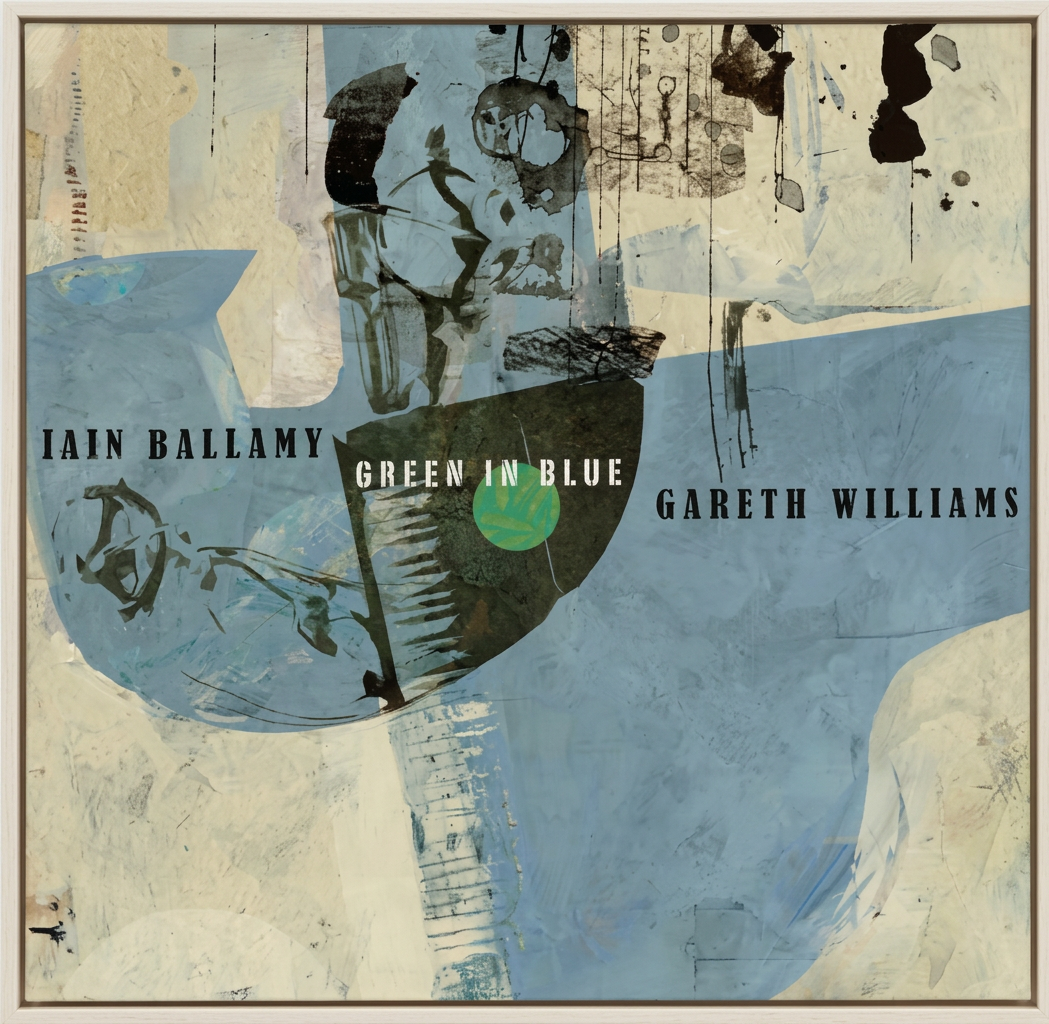
And as a whole the album – splendid cover art by Dave McKean (above) – is far better than the perfectly OK Paul Edis & Noa Levy album Portrait in Evans also in the Evans domain and contemporaneous as a 2026 reference.
Also factored in is a delicious reminder of Short Stories given the inclusion of ‘Short Story’ itself from that fine album of 58-year-old Williams’ that Miles Music issued in 2022. It was a work that had the much missed Martin “Marv” France on it and Belonging band giant of jazz Palle Danielsson on double bass alternating with Chris Laurence known for his work with John Taylor.
France and Williams were years earlier in Iain’s band Anorak heard on the wry and witty More Jazz that Basho got behind at the time.

Ralph Moore feat. David Kikoski, Convergence, Cellar Live/La Reserve ****
Recorded on 16 February this year at a studio in the Canadian city of Vancouver you’ll find Moore and Kikoski originals tailored imaginatively within the best traditions of hard bop and three standards that fit in well.
Seventy in December the tenorist grew up in south London before emigrating to California as a teenager. Ralph Moore then moved to Boston to study at Berklee and later in New York from the 1980s on built a reputation as a side person playing with icons like Horace Silver for years.
He was in Kevin Eubanks’ house band on The Tonight Show with Jay Leno starting in 1995.
On this recording Moore co-produces with pianist David Kikoski, who contributes four new originals and injects harmonic tension into the date. Anchoring the rhythm section are the great Bill Charlap trio bassist Peter Washington and drummer Lewis Nash (known for his work with Betty Carter) who propel the session with buoyant swing and responsive interplay.
Convergence sits squarely in the post-bop and modern acoustic mainstream tradition – muscular, swinging, and rooted in conversational quartet chemistry rather than boring ultra processed smoke and mirrors studio artifice.
Listeners drawn to the authority of Joe Lovano, George Coleman, Seamus Blake, or Eric Alexander – or classic quartet dates like Joe Henderson’s So Near, So Far (Musings for Miles), Branford Marsalis’ Contemporary Jazz, and Moore’s own Furthermore (1990) – will find plenty to savour here.
The programme opens with ‘How About You,’ a brisk, swinging take on Burton Lane and Ralph Freed’s 1941 standard originally introduced by Judy Garland and Mickey Rooney in the musical Babes on Broadway.
From there, Kikoski’s compositional voice takes centre stage across three consecutive originals: ‘Calico’s Strut,’ built around an infectious, syncopated groove that lets Moore dig into the bluesier corners of his register; ‘Augmentation,’ which underlines the pianist’s fondness for modern, intervallic harmony while giving Washington and Nash room to stretch the pulse; and ‘Presage,’ a brooding, forward leaning piece that pushes Moore’s phrasing into more exploratory territory.
Midway through, David Raksin’s haunting 1944 film-noir theme ‘Laura’ – the interpretation I like best on the whole album – a classic that was released with Johnny Mercer’s lyrics by Woody Herman and His Orchestra (the First Herd: clarinettist Woody sings the first chorus) in 1945 – becomes an unhurried showcase for Moore’s warm balladry. The power of a haunting melody like this cannot be underestimated 80 plus years on.
Kikoski then returns with his fourth and final contribution, ‘Can I Tell You Something?’ a conversational mid-tempo piece highlighting the give-and-take between saxophone and piano.
Moore and Kikoski go way back together
Written specifically for this session by Moore himself, the title track ‘Convergence’ recalls the cohesive quartet writing heard across his earlier leader dates such as 623 C Street (1987) [above]
The album closes on John Klenner and Sam M. Lewis’ evergreen fom 1931 Just Friends,’ later revitalised by Charlie Parker, here given an energetic, straightahead send-off. (Washington with Bill Charlap did a beautiful version of ‘Street of Dreams‘ issued by Blue Note in 2021 on the Victor Young tune popularised by Russ Columbo in the 30s that Lewis also set words to.)
I felt both challenged and comforted as a listener. Challenged by the ferociously accomplished quality of the playing and comforted by the standards. There is a logic to what is presented on Convergence and a heat generated that lifts it from being clinical or safe.

Roman Babik wins WDR Jazz Prize
2026 has proved a strong year for German jazz – take a look at marlbank’s top Euro jazz album selection for an indication. And there’s more: take what Roman Babik is doing. The pianist and composer whose chamber jazz styled A Lover’s Tale with violinist Christopher Huber was released this year has also now been named the latest recipient of the WDR Jazz Prize it’s just been announced.
The award, which honours musicians whose work or life is centred in the state of North Rhine-Westphalia, carries a €10,000 (£8,500) endowment alongside a CD production and a concert tour with the WDR Big Band. Additionally, the Young Talent Prize has been awarded to the University of Bonn Jazz Choir and its director Jan-Hendrik Herrmann.
WDR 3 programme director Matthias Kremin said the awards reflected the strength of the regional music scene. “Jazz stands for creativity, freedom, and the interplay of different voices,” he remarks. “North Rhine-Westphalia has an exceptionally strong and diverse scene for it. With these two prizes, we are making its quality visible and, by supporting young talent, simultaneously investing in its future.”
Winners were selected by a jury comprising concert organisers, North Rhine-Westphalia jazz community participants, the WDR 3 jazz editorial team and members of the WDR Big Band.

Leon Buckley Is Named Young Irish Jazz Musician For 2026
Leon is a third-generation saxophonist, following his father Michael Buckley whose Ebb and Flow was a big Irish jazz 2025 highlight and grandfather Dick Buckley. Leon’s uncle is the No Guru, No Method, No Teacher and Poetic Champions Compose Van Morrison saxophonist Richie Buckley. In the video Leon is playing in County Down venue Magy’s Farm a Return to Casual tune by US saxist Walter Smith III
Dublin saxophonist Leon Buckley has won the Young Irish Jazz Musician 2026 award following a live final at the University Concert Hall in Limerick on Sunday. Organised by the Limerick Jazz Society, the biennial competition showcases emerging jazz performers aged 16 to 23 from across the island of Ireland. Buckley, a fourth-year student on the BA in Jazz and Contemporary Music Performance programme at Dublin City University and a past pupil of Templeogue College, secured the title ahead of five fellow contenders.
During the evening showcase, all six finalists – Buckley, Savannah Lauryn, Nayan Levy, Thomas O’Donovan, Sylvan Mayer Whitla, and Edan Bradley – performed alongside a professional house band before a judging panel and a live audience.
As part of his prize, Buckley receives a €1,000 bursary to support further study, recording or performance alongside an invitation to appear at the Limerick Jazz Festival which takes place annually in September.
Limerick Jazz Festival organisers noted that all six finalists demonstrated “incredible talent and passion for jazz,” describing the concert as “a wonderful celebration of the next generation of Irish jazz musicians” and adding that “the future of Irish jazz is in great hands”.
The Improvised Music Company congratulated Buckley on what it termed “a well-deserved recognition of such an exciting young talent,” confirming it looks forward to working with him and his fellow finalists in the future.
Dublin City University’s School of Theology, Philosophy and Music also highlighted Buckley’s achievement to its academic community as he completes his final year of undergraduate study.
The 2026 event marked the third time the University Concert Hall has staged the competition, which was established to provide a national platform and career springboard for young instrumentalists and vocalists.
Winners of the award previously – both pianists – were Rory Conneally two years ago and Nils Kavanagh in 2022.

Richard Wyands: sleeves of desire
Thirty four years in the shadows before claiming the trio spotlight, reflect on the Wyands whys and wherefores
Gone but not forgotten
On Richard Wyands who died in his 90s six months before the first Lockdown.
If you own a classic jazz record from the 1960s, there is a very good chance you know the sound of Richard Wyands – even if you do not immediately recognise his name, fellow shuffler in the anorakerie. Hoking in the bins, you spot him everywhere on the sleeve notes before you ever see him on the front cover. He was the pianist whom the titans trusted when the red light flicked on, lending crystalline poise to Rahsaan Roland Kirk’s We Free Kings and Oliver Nelson’s Straight Ahead, or locking into a telepathic groove with Charles Mingus. Yet for all that studio ubiquity, Wyands spent decades tucked cleanly out of the spotlight – a classic “musician’s musician” in an industry that tends to reserve its myth making for “front men”, or as JazzTimes succinctly put it, a “remarkably fine musician” who remained “unfairly neglected during his prime.”
Listen: Rahsaan Roland Kirk – “We Free Kings” (1961), featuring Richard Wyands on piano
Born in Oakland, California in July 1928 and raised across the bay in Berkeley, Wyands took up the piano at seven under a neighbour’s classical tutelage. Billed locally as something of a child prodigy, he soon traded Chopin for the records of Teddy Wilson, Nat King Cole, and Count Basie, joining the musicians’ union at sixteen to play wartime dances and Bay Area clubs before earning a music degree from San Francisco State College in 1950. That grounding led straight to his gruelling apprenticeship at the storied Black Hawk nightclub.
Working the house and intermission chair on a relentless “forty on, twenty off” schedule, he was tasked nightly with holding the room immediately after giants like Art Tatum and Erroll Garner had just dazzled the crowd. Rather than trying to out-muscle those virtuosos, Wyands distilled stride, swing, and bebop into something far rarer: harmonic transparency, impeccable time, and an almost ego-free sense of proportion.
That rare musical empathy quickly carried him beyond California – first for a ten-month club stint in Ottawa, and then on to the road as musical director for Ella Fitzgerald and accompanist to Carmen McRae, with whom he finally landed in New York in 1958. Once in the Apple, he became what WBGO’s Nate Chinen called “a pianist whose articulate touch and sensitive phrasing made him a first-tier accompanist,” backing vocalists like Dinah Washington and Etta Jones (anchoring her Grammy Hall of Fame classic Don’t Go to Strangers), while Benny Carter, Gigi Gryce, and guitarist Kenny Burrell – whom he toured and recorded with from 1964 to 1977 – kept him by their side for years. As guitarist Peter Bernstein later observed, playing with Wyands made everyone else on the stand hear themselves – and the music around them – with greater clarity. Where other pianists might clutter the harmony, Wyands cleared space, acting as both safety net and springboard.
Roaring into life: guv – cop this: Kenny Burrell Quartet at the Apollo during the Newport Jazz Festival in July 1973 featuring Richard Wyands on piano, Larry Ridley on double bass, and Oliver Jackson on drums
Best of all, though, is how late he stepped out from behind the curtain. Having started professionally in 1944, Wyands waited thirty-four years before cutting his leader debut, Then, Here and Now, for Storyville in 1978 at fifty. Far from a victory lap, it proved the prelude to a golden late-career run in the 1990s – well into his sixties and seventies – that finally showcased his trio mastery on his own terms across standout Criss Cross, SteepleChase, and Venus dates like Get Out of Town and Lady of the Lavender Mist. As All About Jazz noted of his late-period artistry, “Wyands is not a flashy pianist; he is a pianist of thoughtful, deeply felt emotion.” Even into his final years, before his passing in Manhattan in September 2019 at 91, he could still be found holding court at a weekly residency at Lower Manhattan’s 75 Club.
Watch after the Spanish language introduction the Richard Wyands Trio live in 1991 at New York’s Village Vanguard with Frank Wess playing for instance a Joe Henderson classic ‘Recorda Me’ and in Spain with Reggie Johnson and Alvin Queen on Freddie Hubbard’s evergreen ‘Up Jumped Spring’
In an era when contemporary jazz piano so often prizes maximalist fireworks or sprawling post-classical ambition, Wyands’s unhurried poise feels downright radical – and you can hear its quiet DNA alive and well across the Atlantic today. Think of the lyrical restraint of British stylists like Liam Noble, John Taylor’s legacy in the hands of Kit Downes, or the crisp, conversational swing of European trio craftsmen such as Denmark’s Nikolaj Hess. Like Wyands, they understand that touch, space, and deep listening beat sheer volume every time, reminding us that the quietest voice on the bandstand is often the one holding the whole conversation together.
Essential Wyands Listening
- As Sideman: Etta Jones – Don’t Go to Strangers (Prestige, 1960); Rahsaan Roland Kirk – We Free Kings (Mercury, 1961); Oliver Nelson – Straight Ahead (New Jazz, 1961)
- As Leader: Richard Wyands Trio – Then, Here and Now (Storyville, 1978); Get Out of Town (SteepleChase, 1997); Lady of the Lavender Mist (Venus, 1998)


You must be logged in to post a comment.